📖 Deep Dive
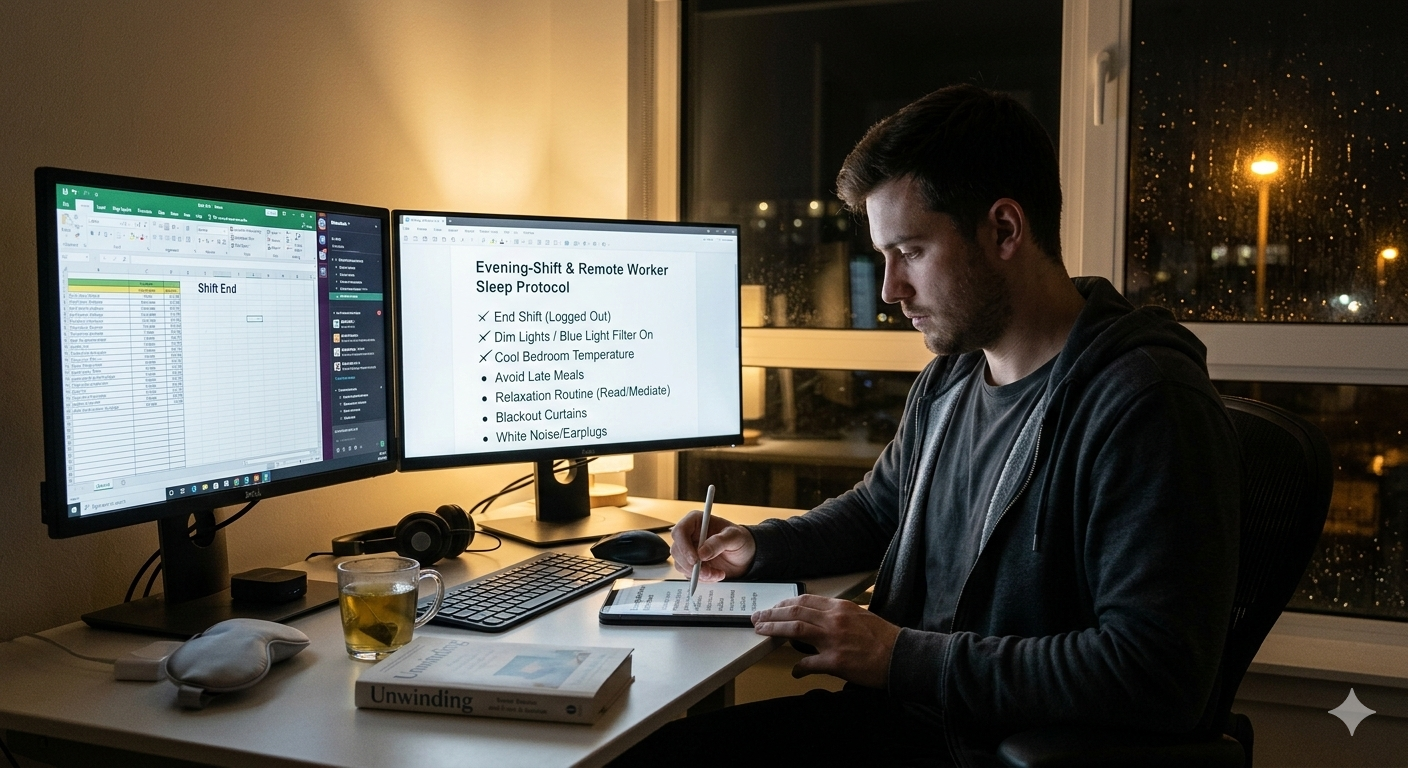
Sleep Protocol for Evening-Shift & Remote Workers in Winter: Circadian Reset + Strategic Naps
Target reader: a busy remote or evening-shift professional juggling irregular hours, indoor winter work, and performance demands. This protocol gives a science-first, practical plan to preserve deep sleep, sharpen daytime alertness, and reduce immune and mood dips common in winter. Expect step-by-step timing, bedroom checklists, sleep-tracking interpretation, and two evening routine templates you can start tonight.
Why this works — circadian science in 60 seconds
Your sleep timing is controlled by two interacting processes: the circadian system (the biological clock that times melatonin release) and sleep pressure (adenosine buildup). Light is the master cue for circadian phase, especially blue light in the morning and early evening. In winter, reduced daytime light and more indoor lighting delay or weaken your melatonin signal, while irregular schedules fragment sleep architecture (less slow-wave and REM). This plan restores a strong circadian anchor, times short naps to lower adenosine without impairing nocturnal sleep, and protects deep sleep through environment and pre-sleep physiology.
Overview: Quick wins (start tonight)
- Anchor one daily bright-light exposure — 20 minutes within 90 minutes of waking (outside or 5,000-lux light box).
- Schedule a power nap (20–30 minutes) or a controlled 90-minute nap depending on sleep opportunity and shift timing.
- Dim lights and drop temperature 90–120 minutes before your main sleep to trigger melatonin and slow metabolism.
Detailed protocol — timing & actions
When your main sleep starts between 22:00–02:00 (typical evening workers)
- Wake / Phase anchor — 07:00–09:00: 20 minutes outside or 10,000-lux lightbox for 20 minutes within 90 minutes of waking. This advances melatonin onset and stabilizes circadian phase.
- Midday — 12:00–15:00: 20–30 minute power nap if alertness dips. Keep 20–30 minutes to avoid deep-sleep inertia; for long sleep deficits use a 90-minute nap earlier in the day.
- Afternoon low-light caution — 17:00–19:00: Avoid bright screens close to your chosen sleep anchor. Bring light exposure earlier in day to prevent late melatonin suppression.
- Pre-sleep window — 2 hours before bed: Dim overhead lights to <50 lux, switch to warm (≤3000K) lighting at least 90 minutes before bed. No screens 60 minutes before bed; if needed use blue-blocking glasses.
- 30–90 minutes before bed: Cool bedroom to 16–18°C, complete 10–15 minutes of relaxation breathing or a short cold-heat contrast shower (see recovery link below) ending cool to drop core temperature and speed sleep onset.
- Bedtime: Consistent sleep onset time within ±30 minutes on work and off days to protect REM and slow-wave consolidation.
Evening routine templates (pick one)
Template A — Early anchor (best if you wake 07:00–09:00)
18:30 — Dim lights to lamps, switch devices to warm mode.
19:15 — 20 minute light stretching; hydrate; avoid heavy carbs.
20:00 — 15-minute relaxation breathing (box or 4-6-6), read low-stimulation book.
21:00 — Cool shower ending cool; lights out by 21:30–22:00.
Template B — Late-shift finishers (sleep starts 01:00+)
22:00 — Bright light exposure off; wear blue-blockers until ready for bed.
23:00 — Small high-protein snack if hungry; 10–15 minutes light stretching.
00:00 — Breathing practice or 10-min mindfulness; room temperature 16–18°C.
01:00 — Bedtime with blackout, no screens.
Bedroom environment checklist
- Temperature: 16–18°C for most adults (supports sleep-stage consolidation and lowers sleep latency).
- Light: Blackout curtains, dimmable warm bedside lamp, remove visible electronics; <50 lux during pre-sleep hour.
- Sound: <30 dB baseline; use white noise or earplugs if necessary.
- Bedding: Breathable mattress and covers for thermoregulation; pillow supporting neutral neck posture.
- Air quality: Fresh air or gentle air filtration; humidity 40–60% in winter to reduce nose dryness and snoring risk.
Nap comparison table — pick what fits your schedule
| Nap Type | Duration | Best Use | Effect on Night Sleep |
|---|---|---|---|
| Power nap | 20–30 min | Midday alertness, prevents adenosine peak | Minimal if >6 hours before main sleep |
| Recovery nap | 60–90 min | After long nights or sleep loss | Can reduce sleep pressure — keep before late afternoon |
| Polyphasic split | Several short naps | Extreme schedules (short-term) | Higher risk of fragmented night sleep; use only temporarily |
Sleep-tracking interpretation guide
Use metrics to guide adjustments, not as the sole judge. Key markers:
- Sleep onset latency & wake after sleep onset (WASO): Long onset (>30 min) suggests elevated arousal or late blue light; address pre-sleep light and cooling.
- Sleep cycles & REM timing: REM concentrated in later cycles; frequent early awakenings fragment REM. If REM <90 min/night, increase main sleep duration by 30–60 min and stabilize bedtime.
- Slow-wave sleep (SWS): Usually higher early in night. Low SWS with high WASO may indicate sleep fragmentation—check noise, temperature, alcohol, or sleep apnea risk.
- HRV & resting heart rate: Lower HRV and higher RHR across days suggest stress or insufficient sleep; see our HRV basics for interpretation.
For a quick stress reset before bed try our 2–5 minute protocol to reduce arousal and support faster sleep onset: A Simple 2–5 Minute Stress Reset for Beginners.
Common sleep problems & general guidance
- Insomnia (difficulty falling/staying asleep): Reinforce strict light/dark exposure, practice stimulus control (bed = sleep), limit naps to 20–30 minutes early in day.
- Shift work disorder: Anchor bright light near waking, use scheduled naps before night shifts, consider melatonin (0.5–1 mg) 30–60 minutes before daytime sleep — discuss with a clinician.
- Sleep apnea signs: Loud snoring, gasping, daytime sleepiness — consult a sleep specialist; positional therapy and weight management can help.
Winter-specific tips
- Increase morning bright-light exposure in winter — indoor lightboxes can substitute for reduced sun.
- Maintain humidity 40–60% to reduce nasal congestion and improve sleep breathing.
- Use warm layers on bedding but keep ambient room cool; thermal comfort helps deep sleep.
- Try cold-heat contrast recovery to promote parasympathetic activation after evening training: Cold-Heat Contrast Recovery Protocol.
Start by picking one anchor (morning light or a consistent wake time) and one evening habit (dim lights 90 minutes before bed). Small, consistent changes stabilize melatonin timing and allow adenosine to build normally — supporting restorative slow-wave and REM sleep. For personalized data interpretation, pair nightly sleep logs with HRV tracking: learn more on measuring recovery here: HRV Basics. If persistent problems remain, seek evaluation from a sleep clinician.