A Simple 2–5 Minute Stress Reset (Beginner)
When stress spikes, you don’t need a long routine—you need a reliable switch. These beginner-friendly, science-backed tools lower your physiological arousal fast and sharpen your focus in minutes.
Pick Your Window
- 2 minutes: Physiological Sigh Reset (fastest downshift)
- 3 minutes: Panoramic Vision + Label (calm and clarity)
- 5 minutes: Box Breathing Focus Lock (stable focus under pressure)
2-Minute Physiological Sigh Reset
Best for: sudden spikes in stress, pre-meeting nerves, overthinking.
Breath Pattern (Physiological Sigh):
- Inhale through the nose until lungs are ~80% full.
- Take a quick second sip-in through the nose to top off (small sniff).
- Slow, complete exhale through the mouth until empty.
- Repeat for 10–12 cycles (~2 minutes).
Protocol (2:00):
- 00:00–00:20 — 4 cycles, count the exhale 1–6 slowly.
- 00:20–01:20 — 6 more cycles, soften your shoulders on each exhale.
- 01:20–02:00 — Final cycles, whisper “down” on the exhale.
Why it works: The double inhale re-inflates alveoli and reduces CO₂ efficiently; the long exhale recruits the vagus nerve to lower heart rate. A 2023 Stanford-led study (Balban et al.) found cyclic sighing notably improved mood and reduced physiological arousal compared to mindfulness alone.
3-Minute Panoramic Vision + Label
Best for: mental clutter, screen fatigue, feeling boxed-in.
- Panoramic Gaze (90s): Sit or stand. Without moving your head, soften your eyes and widen your visual field to include the edges of the room. Let your breath be natural. This “optic flow” style view signals safety to the nervous system and downshifts sympathetic arousal.
- Affect Label (60s): Quietly name your state in 3–5 words: “I feel tense, hurried, tight.” Research on affect labeling (Lieberman et al., 2007) shows it reduces amygdala reactivity and increases prefrontal control.
- Anchor Breath (30s): 4-second inhale, 6-second exhale, 3 rounds.
Why it works: Widening the visual field reduces threat signaling and helps the body exit “tunnel vision.” Naming emotions increases cognitive control over the stress response.
5-Minute Box Breathing Focus Lock
Best for: performance moments where you need calm concentration (presentations, exams, clutch plays).
Pattern: Inhale 4s • Hold 4s • Exhale 4s • Hold 4s (repeat)
Protocol (5:00):
- 00:00–02:00 — 8 cycles, pace your count with a clock or metronome.
- 02:00–04:00 — 8 cycles, relax your jaw and tongue during holds.
- 04:00–05:00 — 4 cycles, visualize a steady square tracing each side with your breath.
Why it works: Slow, even breathing boosts heart rate variability (HRV), a marker of stress resilience. This supports parasympathetic tone (Porges’ polyvagal theory) and steadies attention under load (see Critchley et al., 2003 on interoception and autonomic control).
One-Minute “Name It, Aim It” Journal (Add-On)
Use after any protocol or alone when time is tight.
- Right now I feel… (name 1–2 emotions)
- What I need most is… (one need: clarity, pause, water, movement)
- My next tiny action is… (one 30–60s step)
Keep it to three lines. Clarity is a stress reducer.
Build the Habit (Cue → Routine → Reward)
Goal: Run one of these resets 2–3 times daily.
- Cue: Phone unlock, calendar alert, or kettle boils.
- Routine: 2-minute Physiological Sigh (or your chosen protocol).
- Reward: Drop your shoulders + say “Reset done.” Then mark a quick check in your tracker below. Small wins reinforce the loop via dopamine.
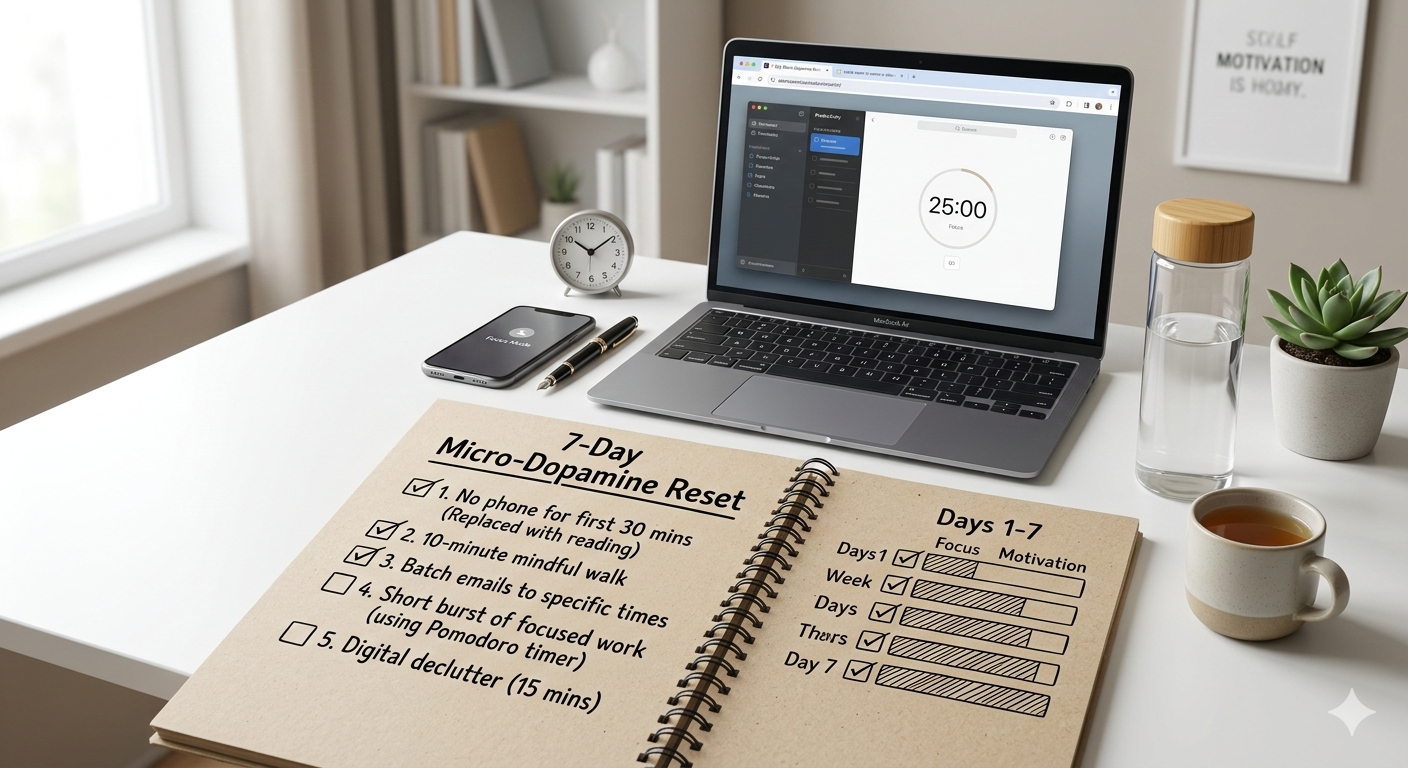
7-Day Micro-Tracker (check off 1–3 resets/day)
- Mon: [ ] morning [ ] midday [ ] evening
- Tue: [ ] morning [ ] midday [ ] evening
- Wed: [ ] morning [ ] midday [ ] evening
- Thu: [ ] morning [ ] midday [ ] evening
- Fri: [ ] morning [ ] midday [ ] evening
- Sat: [ ] morning [ ] midday [ ] evening
- Sun: [ ] morning [ ] midday [ ] evening
2–5 Minute Daily Plan (Beginner)
- Morning (2 min): Physiological Sigh before opening email.
- Midday (3 min): Panoramic Vision + Label after 90 minutes of work.
- Evening (2–5 min): Box Breathing or 3 rounds of 4s inhale/6s exhale before planning tomorrow.
Science Snapshot
- Breathwork > Mind-wandering: A Stanford-led 2023 study (Balban et al.) found 5 minutes/day of structured breathing—especially cyclic sighing—improved mood and reduced physiological arousal more than mindfulness training of equal duration.
- Vagal brake: Slow exhales engage parasympathetic pathways (polyvagal theory; Porges), lowering heart rate and blood pressure.
- Affect labeling: Briefly naming emotions decreases amygdala activity and enhances prefrontal regulation (Lieberman et al., 2007).
- Attention and HRV: Even-paced breathing improves HRV, linked to better stress resilience and executive function (e.g., Critchley et al., 2003).
Pro Tips for Consistency
- Stack it: Attach your 2-minute sigh to an existing routine: after handwashing or after you sit down for a meeting.
- Use visual cues: Put “Breathe: 2 min” on your laptop bezel or phone lock screen.
- Make it obvious and easy: Start with one protocol at the same time daily for 5 days. Then add a second slot.
- Track wins: A single check mark gives the brain a reward signal. Streaks matter more than duration for habit formation at first.
Quick Troubleshooting
- Mind racing? Count just the exhales. If you lose count, restart at 1 without judgment.
- Can’t find 3 minutes? Do 3–5 cycles of the Physiological Sigh—still effective.
- Shallow breaths? Sit upright, place a hand on your low ribs, and breathe into your sides and back.
Safety Note
Practice seated if you feel lightheaded. If you have respiratory or cardiovascular concerns, consult a medical professional before starting new breathwork.
Reflection Prompts (End of Day, 2 Minutes)
- When today did I notice stress earliest, and which tool helped most?
- What cue worked to remind me to reset? How can I make it more obvious tomorrow?
- What single improvement would make tomorrow 1% calmer?
Bottom line: Two to five minutes is enough to change your state. Breathe to lower arousal, widen your view to signal safety, label to regain control—then act on the next tiny step.