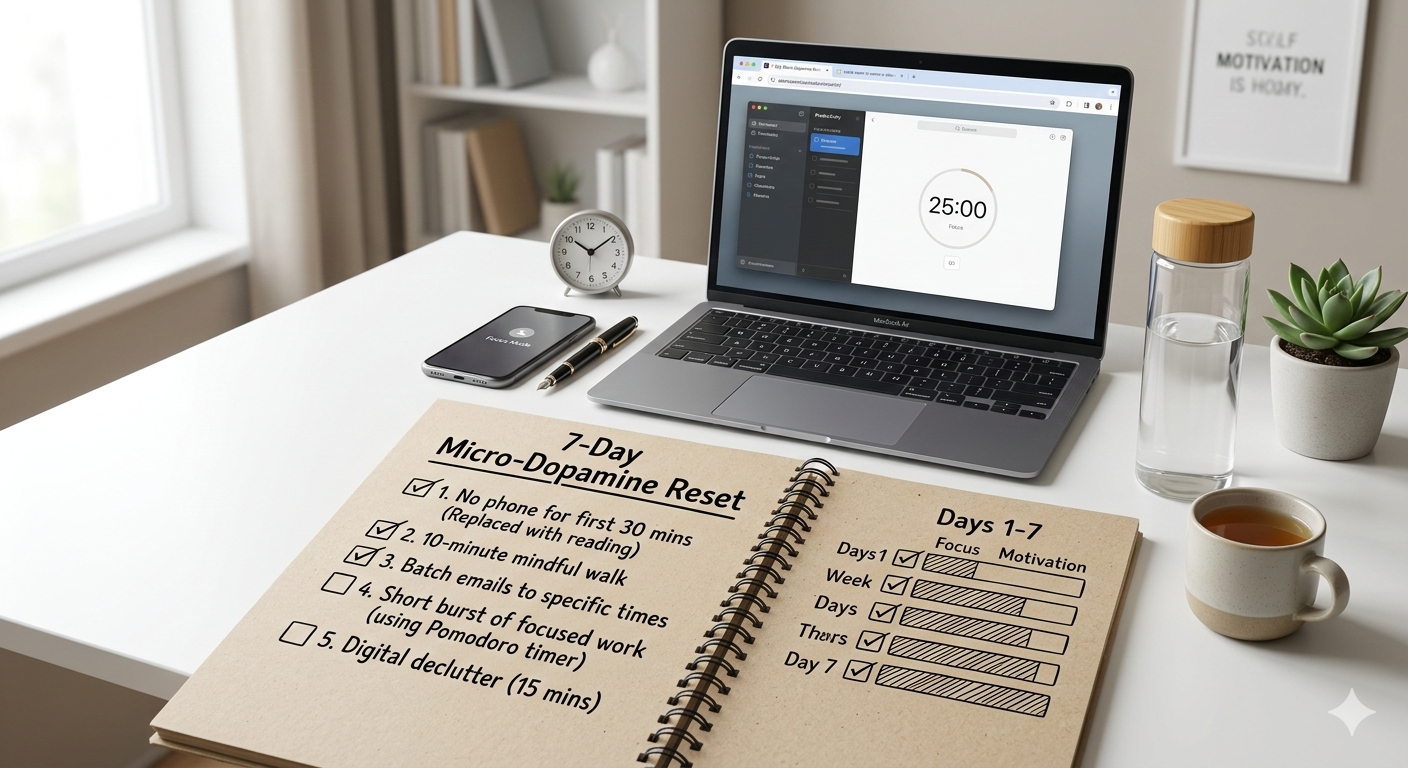
7-Day Micro-Dopamine Reset for Winter Focus & Motivation (Without Quitting Your Phone)
You don’t need a full “digital detox” to regain your focus and motivation this winter. You need a smarter relationship with dopamine — the brain’s motivation and anticipation chemical.
This 7-day micro-reset is a practical mindset program you can run alongside a normal busy week. No disappearing into a cabin, no deleting every app. Just small, evidence-based shifts that train your brain to:
- Reduce compulsive scrolling
- Increase deep-focus capacity
- Make boring tasks feel more doable
- Sleep better and wake with more mental energy
Average time per day: **15–20 minutes** of intentional practice, built around things you already do.
Why Dopamine Is Hijacking Your Winter Focus
Dopamine itself isn’t “bad.” It’s how the system is being triggered.
- Short-form content & notifications create constant tiny dopamine spikes.
- Over time, your brain starts to find normal, slower rewards (reading, deep work, studying, planning) comparatively dull.
- Winter amplifies this: lower daylight, more indoor time, and often lower mood mean more reliance on quick digital hits.
Neuroscience studies from Stanford and others show that frequent dopaminergic “hits” without effort can reduce motivation for longer, effortful tasks. The goal of this reset is not to remove dopamine, but to **re-link it with effort, progress, and real-world rewards**.
Core Framework: The 3Rs Dopamine Reset
Every day this week you’ll train three skills:
- Recognize – Notice when you’re chasing quick dopamine (scrolling, tab hopping, snack grazing).
- Re-route – Insert a 30–60 second “pattern breaker” that involves breath + body + intention.
- Reward – Give your brain a small but clear win tied to effort (micro-task completion, a checkmark, a short walk).
Think of it as upgrading your internal operating system so digital tools work for you, not on you.
Pre-Work (One Time – 10 Minutes)
Step 1: Map Your Top 3 Dopamine Drains
Take 5 minutes and answer in a journal or notes app:
- When do I lose the most time on my phone? (e.g., in bed, after lunch, between tasks)
- Which apps grab me the hardest?
- What am I usually avoiding when I reach for my phone? (boredom, fatigue, stress, difficult task)
Choose ONE time-window + ONE app you’ll focus on for this 7-day reset. That’s it. Narrow beats heroic.
Step 2: Install a Visible Cue
Dopamine habits run on autopilot. We’ll interrupt the loop at the “cue” stage:
- Place a small sticky note on your phone or laptop with: “Pause → 3 breaths → Choose”
- Or change your lock screen to a simple text image with that phrase.
This is your reminder to run the 3Rs protocol instead of going straight into scroll mode.
The 7-Day Micro-Dopamine Reset
Daily Anchor: The 60-Second Reset Ritual
🚦 60-Second Reset (Use whenever you notice “mindless reach” for your phone)
- Notice your hand going to the phone or browser tab.
- Stop with your hand still there. Don’t yank it away; just freeze.
- Do 3–5 breaths:
- Inhale through the nose for 4 seconds
- Exhale through the mouth for 6 seconds
- Slight emphasis on a longer exhale — this calms the autonomic nervous system. - Ask one question: “What do I actually need right now?”
Choices: information, escape, rest, connection, progress. - Act on the true need (see daily protocols below).
Neuroscience note: longer exhales engage the parasympathetic (“rest & digest”) branch, lowering physiological arousal. This gives your prefrontal cortex (decision center) a chance to come back online before you act.
Day 1–2: Taming the First & Last 10 Minutes of Your Day
Winter mornings and nights are where phone habits explode. We’ll reclaim those bookends.
Morning Protocol (5–7 minutes)
- Keep your phone in another room or at least 2 meters from the bed.
- On waking: sit up, feet on floor. Before touching any device:
- Do 5 rounds of “Physiological Sigh” breathing:
- Short inhale through the nose
- Second quick inhale to “top off” the lungs
- Long, complete exhale through the mouth
(Shown in research from Stanford’s Huberman Lab to rapidly reduce stress.) - Then say out loud: “Today I’m training my attention.”
- Do 5 rounds of “Physiological Sigh” breathing:
- Only then check your phone, ideally starting with something intentional (calendar, plan, or a single important message).
Night Protocol (5–10 minutes)
- Set a “phone curfew” alarm 45–60 minutes before sleep.
- At the alarm, run the 60-Second Reset and plug your phone away from the bed.
- Replace scrolling with one of:
- 3–5 pages of a physical book
- 5 minutes of gentle stretching
- Short journal entry (see prompts below)
Night Journaling Prompts (3 minutes)
- When did I feel most pulled to my phone today? What was I avoiding?
- Where did I successfully choose effort over easy dopamine?
- One tiny thing I want to improve tomorrow:
Day 3–4: Rewiring Boredom & Task Switching
Now we train your brain to tolerate boredom and stay with one task long enough to feel reward.
Focus Sprint Protocol (10–15 minutes)
Single-Task Sprint
- Choose one short, slightly uncomfortable task (admin email, organizing one folder, reading 3 pages of a dense article).
- Set a 10-minute timer.
- Put phone in another room or on airplane mode.
- Start the task. Every time you feel the urge to check something:
- Mark a tally on a sticky note.
- Say in your head: “Stay with it for 60 more seconds.”
- At the end of 10 minutes, stand up and reward yourself with:
- 30–60 seconds of movement (jumping jacks, brisk walk, stretching)
- Or a small positive ritual: checkmark on a visible progress tracker
This links dopamine to completion and effort, not just novelty.
Optional: If you track biometrics, notice how your heart rate variability responds over the week. Better regulation often shows up as improved HRV.
Day 5–6: Using Your Body to Regulate Cravings
Dopamine loops are not just in your head. They’re in your nervous system. We’ll use simple breath and movement to downshift the urge.
2-Minute “Craving Wave” Protocol
Use when you feel a strong urge to scroll, snack, or tab-hop.
- Name it: “This is a dopamine wave.” (Labeling an emotion reduces its intensity – shown in fMRI research from UCLA.)
- Wave Breath – 1 minute:
- Inhale through the nose for 3 seconds
- Hold for 1 second
- Exhale through the mouth for 5 seconds
- Imagine the urge rising and falling like a wave. - Micro-Movement – 1 minute:
- 10 slow squats or 10 wall push-ups, or
- Walk to the farthest corner of your home/office and back.
- Only then decide: use the device intentionally, or return to your task.
Movement + slow exhale breathing engages interoception (awareness of internal signals), which helps you respond instead of react.
Day 7: Design Your “Default Day” Dopamine Plan
Today is about making this sustainable, not perfect.
Default Day Blueprint (10 minutes)
- Morning rule (1 sentence):
E.g., “No social apps until after my first 15 minutes of work or 1 page of reading.” - Work block rule (1 sentence):
E.g., “I work in 25-minute focus sprints, then allow 3 minutes of intentional phone use.” - Evening rule (1 sentence):
E.g., “Phone stays off the bed; last 15 minutes are for stretching or reading.” - Choose 1–2 tools to keep:
- 60-Second Reset
- Single-Task Sprint
- Craving Wave Protocol - Write them somewhere visible for the next 30 days.
Make It Stick: Habit Loop Design
Use the classic cue–routine–reward model:
- Cue: Hand touches phone / feels urge to scroll.
- Routine: Run the 60-Second Reset or Craving Wave Protocol.
- Reward:
- Check a box on a small “Attention Wins” tracker.
- Say “Nice rep” out loud to yourself (sounds cheesy; works). Self-acknowledgment releases small but meaningful dopamine.
Simple 7-Day Habit Tracker
Copy this into your journal or notes app:
Day 1: Morning reset [ ] Night curfew [ ] 60-sec resets used: ___
Day 2: Morning reset [ ] Night curfew [ ] 60-sec resets used: ___
Day 3: Focus sprint [ ] Craving wave used [ ]
Day 4: Focus sprint [ ] Craving wave used [ ]
Day 5: Morning reset [ ] Focus sprint [ ]
Day 6: Craving wave [ ] Night journal [ ]
Day 7: Default day blueprint written [ ]
Closing Reflection (5 Minutes)
End of Day 7, answer:
- What changed in my focus, even slightly, this week?
- When did I feel most in control of my attention?
- What 1 small rule will I keep for the next 30 days?
You don’t need to be perfect. Every time you interrupt an old pattern, take a breath, and choose effort over easy dopamine, you’re literally changing the wiring of your brain.
This winter can be the season you stop letting apps design your attention — and start designing it yourself.