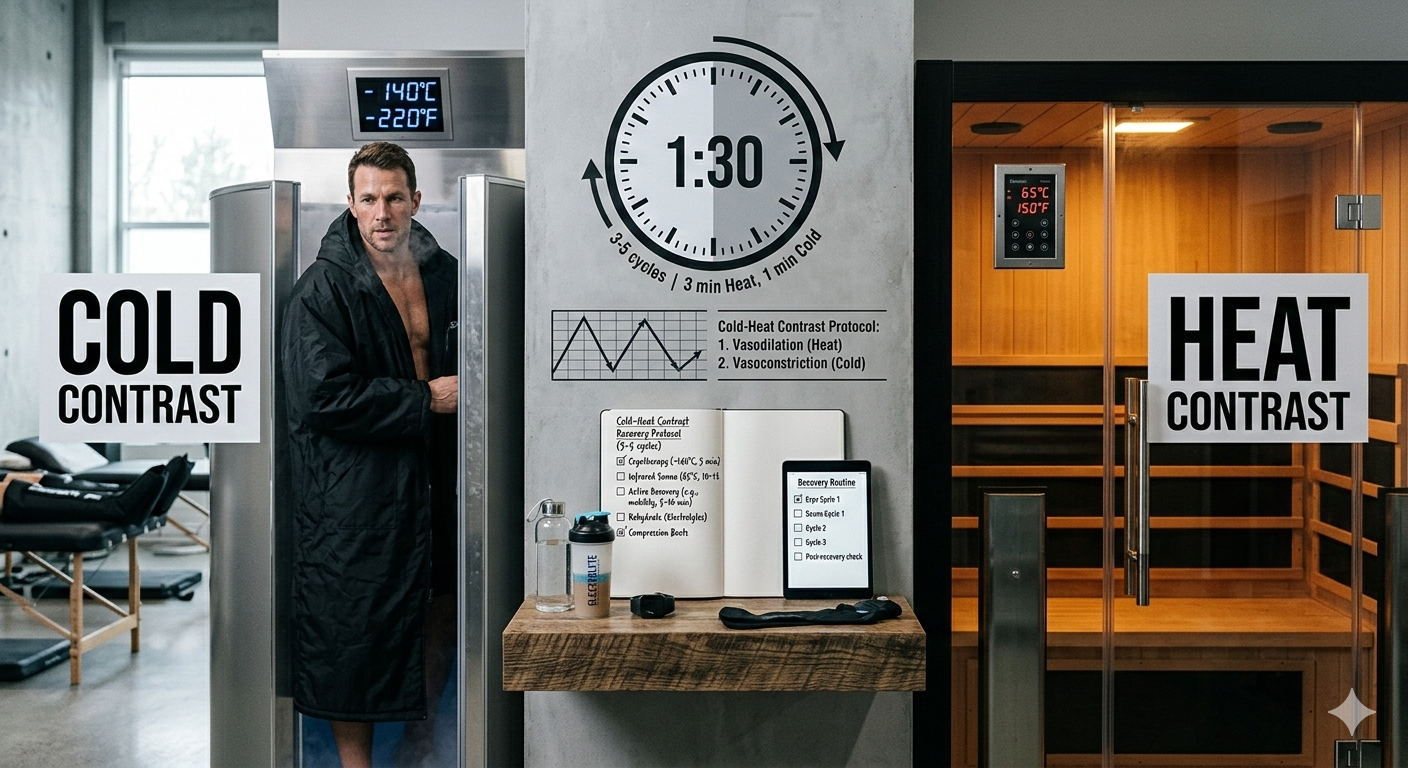
Cold-Heat Contrast Recovery Protocol for Winter Athletes — The NAMOVI Specialist Plan
Target reader: You’re a winter-season endurance athlete or busy weekend warrior training indoors who needs a fast, evidence-based recovery routine to reduce soreness, speed regeneration, and support immune resilience during cold months.
Quick win: A single, 25–40 minute contrast session you can do post-training that reduces muscle soreness, improves circulation, and supports sleep — with exact temperatures, timings, progression, and safety checks.
Why contrast therapy now (science in brief)
Contrast water therapy (CWT) — alternating cold and heat — leverages vascular shear, sympathetic-parasympathetic shifts, and inflammatory modulation. Cold (<=15°C/59°F) causes vasoconstriction, reducing local blood flow and metabolic activity; heat (>=38–42°C/100–108°F) causes vasodilation and increases tissue perfusion. Alternating these induces a “pumping” effect that can reduce edema, accelerate removal of metabolic byproducts, and promote recovery-related signaling (reduced IL-6, transient increases in nitric oxide). Recent meta-analyses show moderate benefits for short-term soreness reduction and perceived recovery when timed within 24 hours of intense exercise.
Overview table — session parameters
| Component | Beginner | Intermediate | Advanced |
|---|---|---|---|
| Cold temperature | 12–15°C (54–59°F) | 10–12°C (50–54°F) | 4–10°C (39–50°F) |
| Cold duration per exposure | 1.5–2 min | 2–3 min | 3–5 min |
| Heat temperature | 38–40°C (100–104°F) | 40–42°C (104–108°F) | 40–43°C (104–109°F) |
| Heat duration per exposure | 3–4 min | 4–5 min | 5–8 min |
| Cycles | 3 cycles (total 20–25 min) | 4 cycles (25–35 min) | 5 cycles (35–45 min) |
| Frequency | 2–3x/week | 3–5x/week | 5–7x/week (monitor signs) |
Step-by-step implementation
- Pre-check (2–5 min): Rest 10–20 minutes after training to normalize heart rate. Assess skin integrity, blood pressure, and cold/heat intolerance. If BP >160/100 mmHg, active infection, open wounds, uncontrolled diabetes, or pregnancy — see contraindications below.
- Set up: For home, prepare two tubs or use a bathtub + shower. Cold: fill with ice to target temperature (use a digital thermometer). Heat: hot water + thermometer to target temp. Equipment options below.
- Start with heat (optional): For stiff joints, begin with 3–5 min heat to increase compliance; otherwise start with cold.
- Perform cycles: Alternate cold then heat per durations in the table. Each cycle = 1 cold + 1 heat. Use a timer and breathe slowly (6–8 breaths/min) during exposures to stimulate vagal rebound during heat phases.
- Finish with cold or heat based on goal: To reduce acute inflammation and soreness, finish with cold. To promote relaxation and sleep, finish with heat.
- Post-session care (10–20 min): Rehydrate (300–600 ml of water), light compression if swelling, gentle mobility (see mobility link below) and a protein + carb snack within 60 min.
- Do NOT use with uncontrolled hypertension, peripheral vascular disease, Raynaud’s disease, severe cardiac disease, open wounds, active infection, or in pregnancy without medical clearance.
- Stop immediately if you experience faintness, severe pain, irregular heartbeat, numbness >2 min after exposure, or prolonged skin blanching/erythema.
- Supervise cold exposures below 10°C for first sessions. Avoid alcohol before/after sessions.
Progression plan (8-week)
| Weeks | Goal | Protocol |
|---|---|---|
| 1–2 | Adaptation | Beginner parameters, 2x/week, finish heat |
| 3–4 | Load tolerance | Intermediate parameters, 3x/week, alternate finish |
| 5–6 | Performance recovery | Intermediate+ parameters, 4x/week, end with cold after intense sessions |
| 7–8 | Advanced conditioning | Advanced parameters, 4–5x/week, include 1 cold-only immersion (3–5 min) weekly |
Compare modalities: Cold vs Heat vs Contrast
- Cold only: Best for acute inflammation (<24–48h) and reducing soreness. Mechanism: decreased metabolic rate, vasoconstriction. Limitation: prolonged cold can blunt hypertrophic signaling if used chronically after resistance training.
- Heat only: Best for stiffness, mobility, and relaxation. Mechanism: increased blood flow, increased tissue temperature, promotion of collagen extensibility.
- Contrast: Balanced approach — reduces edema and aids clearance while retaining heat benefits for mobility; good for repeated sessions and when you need both soreness reduction and relaxed musculature.
Equipment recommendations
- Pro clinic: Dedicated cold plunge tub with chiller (e.g., Ice Barrel Pro, Coldtub) — precise temp control, $1,500–$8,000.
- Home mid-range: Inflatable tub + chest freezer chiller conversion or dedicated stock tank + thermostat chiller — $400–$1,200.
- Budget: Bathtub with ice bags + digital thermometer; shower contrast (2 min cold blast at lowest setting, then hot shower) — $0–$50.
- Accessories: Waterproof digital thermometer, interval timer (watch/phone), neoprene booties/gloves for long sessions if needed.
Timing chart (sample session — Intermediate, 4 cycles)
| Minute | Action |
|---|---|
| 0–2 | Cold immersion 10–12°C |
| 2–6 | Heat immersion 40–42°C |
| 6–8 | Cold 10–12°C |
| 8–12 | Heat 40–42°C |
| 12–14 | Cold 10–12°C |
| 14–18 | Heat 40–42°C |
| 18–20 | Cold 10–12°C (finish cold) |
Stepwise safety checklist
- Measure temperatures with a calibrated digital thermometer.
- Limit cold exposures to recommended durations; insulate core if needed.
- Keep a phone within reach. Have someone nearby for first sessions if doing very cold exposures.
Where this integrates in your winter routine
Use contrast sessions the day after high-volume sessions or pre-race taper days for circulation and sleep benefits. Combine with a light mobility routine — try the Midwinter Desk Rescue mobility flow for targeted stiffness, and pair with an at-home strength plan such as the 6-Week Winter At-Home Strength & Mobility Program or the 8-Week Winter Indoor Hypertrophy & Functional Strength Program for integrated winter training.
Contrast therapy is a practical, evidence-backed tool to accelerate recovery during cold months. Start conservatively, measure your response objectively (sleep, soreness, readiness), and progress only if you tolerate exposures well. When in doubt, consult your physician.