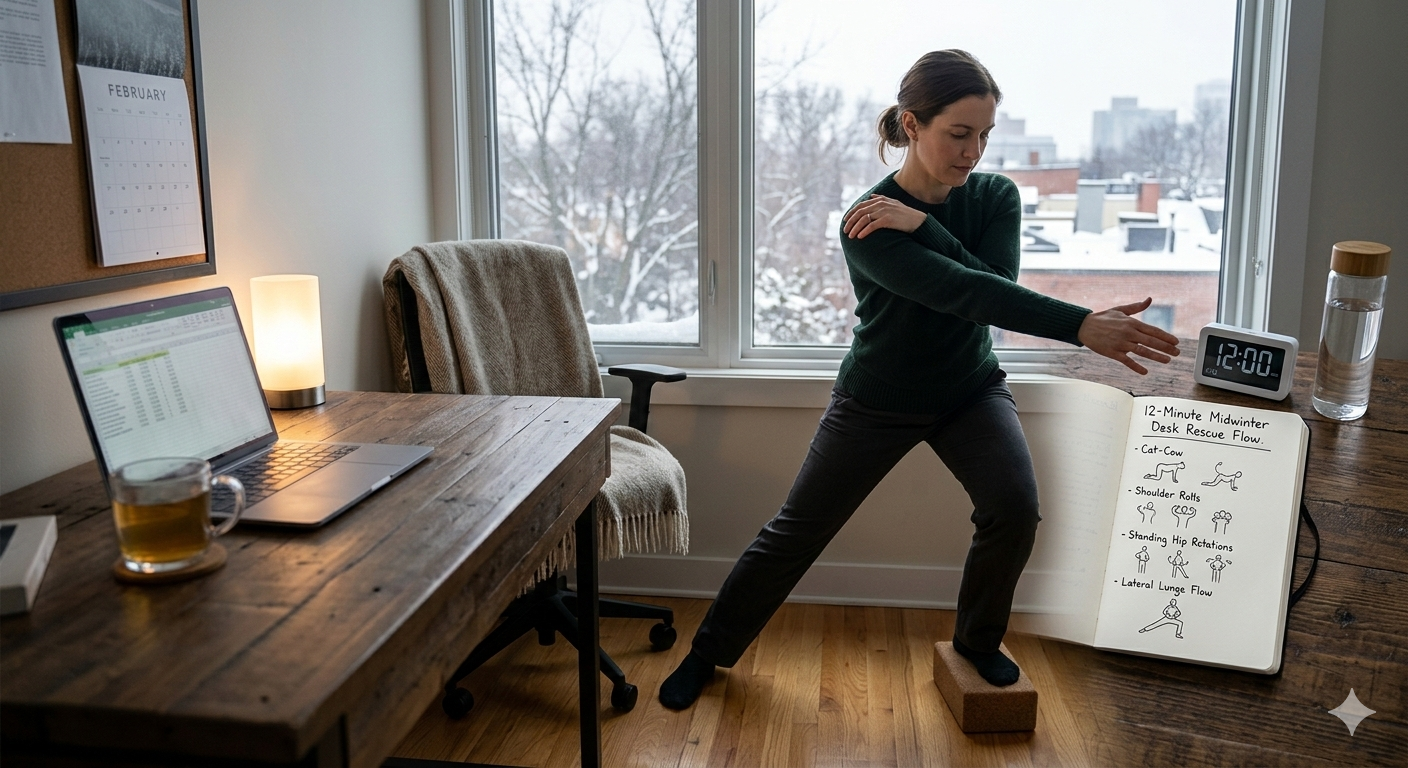
Midwinter Desk Rescue: 12-Minute Hip & Shoulder Mobility Flow
Who this is for: a busy remote worker or parent (30–60 mins/day available) feeling stiff hips, tight low back and shallow shoulders from winter indoor hours. This sequence quickly restores range, reduces pain risk, and primes you for walking, strength work, or a winter hike.
Calm, precise, encouraging — move with intention. Follow the numbered order; each step prepares the next.
Total time: 12 minutes
-
1. Diaphragmatic Breath + Pelvic Reset (Static) — 1:00
Starting position: Supine (on your back) knees bent, feet hip-width on floor.
Execution: Place one hand on chest, one on belly. Inhale 4s through nose expanding belly, exhale 6s through mouth gently drawing navel toward spine. After 3 breaths, perform 3 slow pelvic tilts: inhale release neutral, exhale tilt pelvis posteriorly (flatten low back), hold 2s, return.
Breathing cues: Inhale nose (fill belly), exhale long out through mouth. Use exhale to engage deep core.
Common errors: Chest breathing (hand on chest moves more), forcing tilt with glutes only.
Why it helps: Resets breathing mechanics, improves intra-abdominal pressure control, reduces compensatory lumbar extension that limits hip mobility.
Modification: Do seated if supine is uncomfortable.
Contraindications: Acute abdominal surgery—avoid deep diaphragmatic work until cleared.
-
2. World's Greatest Stretch (Dynamic) — 2:00 (1:00 each side)
Starting position: Standing lunge — right foot forward, left knee down (or both feet up for easier).
Execution: Place left hand down, rotate right elbow inside right foot, then rise into half-kneeling and reach right arm overhead, follow the hand with your eyes. Move fluidly from rotation to overhead reach for 6–8 reps.
Breathing cues: Inhale as you rotate/open, exhale as you return to neutral.
Common errors: Collapsing chest, rotating from lumbar spine instead of thoracic rotation.
Why it helps: Mobilizes hip flexors, hamstrings, and thoracic spine—key areas tightened by sitting that limit gait and shoulder function.
Modification: Keep back knee down or perform standing with no kneel.
Contraindications: Recent knee replacement on the kneeling side—perform standing version only.
-
3. 90/90 Hip Internal/External Rotation (Dynamic) — 1:30 (45s each side)
Starting position: Seated or on mat with hips and knees at 90° (one leg in front, other to the side).
Execution: Rock forward and back over the front hip to find range, then actively rotate the front knee inward (internal) and outward (external) with control, 8–10 slow reps.
Breathing cues: Inhale prepare, exhale as you rotate/open.
Common errors: Using lumbar spine instead of hip; letting pelvis tilt excessively.
Why it helps: Targets deep hip capsule and glute/piriformis mobility—reduces anterior hip pinching and low back referral.
Modification: Sit on a cushion to reduce hip flexion angle.
Contraindications: Acute hip labral tears—avoid deep internal rotation unless cleared.
-
4. Couch Stretch — PNF-style (Static/PNF) — 2:00 (1:00 each side)
Starting position: Kneel with front of one ankle against a wall or couch (hip extended).
Execution: Find a mild stretch in front of hip. Perform a contract-relax: gently contract glute/hamstring of the front leg into the floor for 6s (push without moving), relax 2s, then gently sink deeper into stretch and hold 30s. Repeat on other side.
Breathing cues: Smooth inhales, long exhales during relax phases to promote release.
Common errors: Overarching lumbar spine; pulling pelvis forward—keep ribs stacked over pelvis.
Why it helps: PNF increases muscle length via autogenic inhibition—effective for tight hip flexors common after long sitting in winter.
Modification: Use a rolled towel behind the knee if ankle on wall is sensitive.
Contraindications: Recent ACL/hip replacement on that side—check with clinician.
-
5. Thoracic Openers on All Fours (Dynamic) — 1:00
Starting position: Quadruped (hands under shoulders, knees under hips).
Execution: Place right hand behind head, rotate right elbow toward left knee (threading), then open elbow to the ceiling focusing on thoracic extension. 8 reps per side.
Breathing cues: Inhale open; exhale return to neutral.
Common errors: Moving from lumbar spine; let ribs rotate, keep pelvis stable.
Why it helps: Restores thoracic rotation and extension—improves shoulder overhead reach and reduces neck strain.
Modification: Keep feet wider for more stability or perform seated twists.
Contraindications: Unstable wrists—perform on fists or from seated.
-
6. Doorway Pec Stretch (Static) — 1:00 (30s each side)
Starting position: Standing in doorway, forearm on frame at 90° elbow height.
Execution: Step forward with opposite leg until you feel a gentle anterior shoulder/chest stretch. Hold 30s each side.
Breathing cues: Slow even breaths; exhale relax into stretch.
Common errors: Hunching shoulders forward; over-rotating pelvis—keep neutral spine.
Why it helps: Opens tight pectoralis and anterior shoulder structures from rounded winter posture; improves scapular alignment.
Modification: Adjust arm height to target different pectoral fibers.
Contraindications: Recent shoulder dislocation—only perform under clinician guidance.
-
7. Scapular Wall Slides (Dynamic) — 1:00
Starting position: Stand with back against a wall, arms in a “W” shape, elbows bent.
Execution: Slide arms slowly up to a comfortable height keeping contact with wall (head, upper back, sacrum). 10 controlled reps.
Breathing cues: Inhale up, exhale down with control.
Common errors: Letting ribs flare or arching low back—keep abdominals gently engaged.
Why it helps: Strengthens scapular upward rotation and posterior shoulder tissues, improving posture and reducing impingement risk.
Modification: Perform seated or with hands on a sliding surface (paper or towel) if wall is too challenging.
Contraindications: Shoulder pain with elevation—stop and consult if sharp pain occurs.
-
8. Hip CARs (Controlled Articular Rotations) — Dynamic — 1:00 (30s each side)
Starting position: Stand holding a support, weight on one leg.
Execution: Slowly lift the other knee, circle the hip through its available range clockwise then counterclockwise—keep motion slow and controlled. 3–4 circles each direction.
Breathing cues: Exhale as you move through the challenging part of the circle.
Common errors: Swinging limb, flexing torso—keep core stable and move only at the hip joint.
Why it helps: Restores true joint mobility and neuromuscular control—super beneficial before strengthening or stepping outdoors into winter trails.
Modification: Reduce circle size or perform seated hip rotations.
Contraindications: Advanced osteoarthritis—keep range within comfort and consult provider.
-
9. Forward Fold with Ankle Dorsiflexion (Static) — 1:00
Starting position: Standing feet hip-width.
Execution: Hinge at hips into a soft forward fold. Bend one knee slightly and actively pull toes toward shin (dorsiflexion) for 20s each side, then full fold 20s. Use hands on shins for support if needed.
Breathing cues: Exhale deeper into the fold slowly, inhale to widen spine.
Common errors: Rounding upper spine—lead with chest hinge.
Why it helps: Improves hamstring length and ankle mobility—important for walking and absorbing uneven winter surfaces.
Modification: Perform seated forward fold.
Contraindications: Acute sciatica with severe pain—modify or avoid deep hamstring tension.
-
10. Standing Reset & Integration (Dynamic) — 1:30
Starting position: Stand tall feet hip-width, soft knees.
Execution: March in place with exaggerated hip drive and arm swing for 30s, then perform two slow 30s mini-squats focusing on depth control and even weight distribution. Finish with 15s of balanced standing on each leg (eyes open).
Breathing cues: Breathe naturally; exhale as you stand from squat.
Common errors: Holding breath, collapsing knees inward—track knees over toes.
Why it helps: Integrates mobility gains into functional movement patterns so your body uses new range during daily tasks and winter activities like the Full-Moon Winter Snowshoe or an easy Spring hike.
Modification: Reduce squat depth or perform supported balance with a chair.
Contraindications: Unstable cardiovascular symptoms—stop if dizzy or lightheaded.
Flow order rationale
The sequence begins with breath and core reset, then moves through hip mobility (posterior/anterior capsule), thoracic and shoulder opening, and finishes by integrating mobility into functional movement. This proximal-to-distal approach reduces compensations and safely builds usable range.
Additional guidance & winter tips
- Perform this 1–2× daily during long indoor workdays, especially before stepping outside into cold where joints stiffen.
- Use a short follow-up warm-up (3–5 minutes light cardio) before outdoor winter activities or pair this with the 6-Week Winter At-Home Strength & Mobility Program to lock in gains.
- If you plan a longer winter outing, precede it with this sequence plus dynamic warm-up from our 8-Week Winter Indoor Hypertrophy & Functional Strength Program for more resilience.
When NOT to do these movements
- Acutely inflamed joints, fever, or recent surgical wounds—wait for clinician clearance.
- Neurological symptoms (numbness, progressive weakness) without prior diagnosis—stop and seek assessment.
- Sharp joint pain that worsens with movement—modify or discontinue and consult a healthcare professional.
You’ve just completed a targeted 12-minute mobility reset. Move gently for the next 10 minutes, hydrate, and notice how your posture and comfort change—small consistent investments like this protect your body through long winter months and beyond.